2026-10-09
Choosing a CNC milling cutter usually starts with the material. Aluminum, carbon steel, and stainless steel don’t behave the same way under a cutting tool. Their hardness, heat transfer, chip formation, and tendency to work-harden can all be different.
For manufacturers, machining shops, tooling distributors, and B2B buyers, using one CNC Milling Cutter for every metal can create problems. Poor surface finish, excess heat, built-up edge, vibration, or short tool life may show up pretty quickly. Cutter geometry, carbide grade, coating, flute count, helix angle, and cutting parameters all need to make sense for the workpiece.
This guide looks at common cutter choices for aluminum, steel, and stainless steel, along with the practical points buyers should check when sourcing tooling.
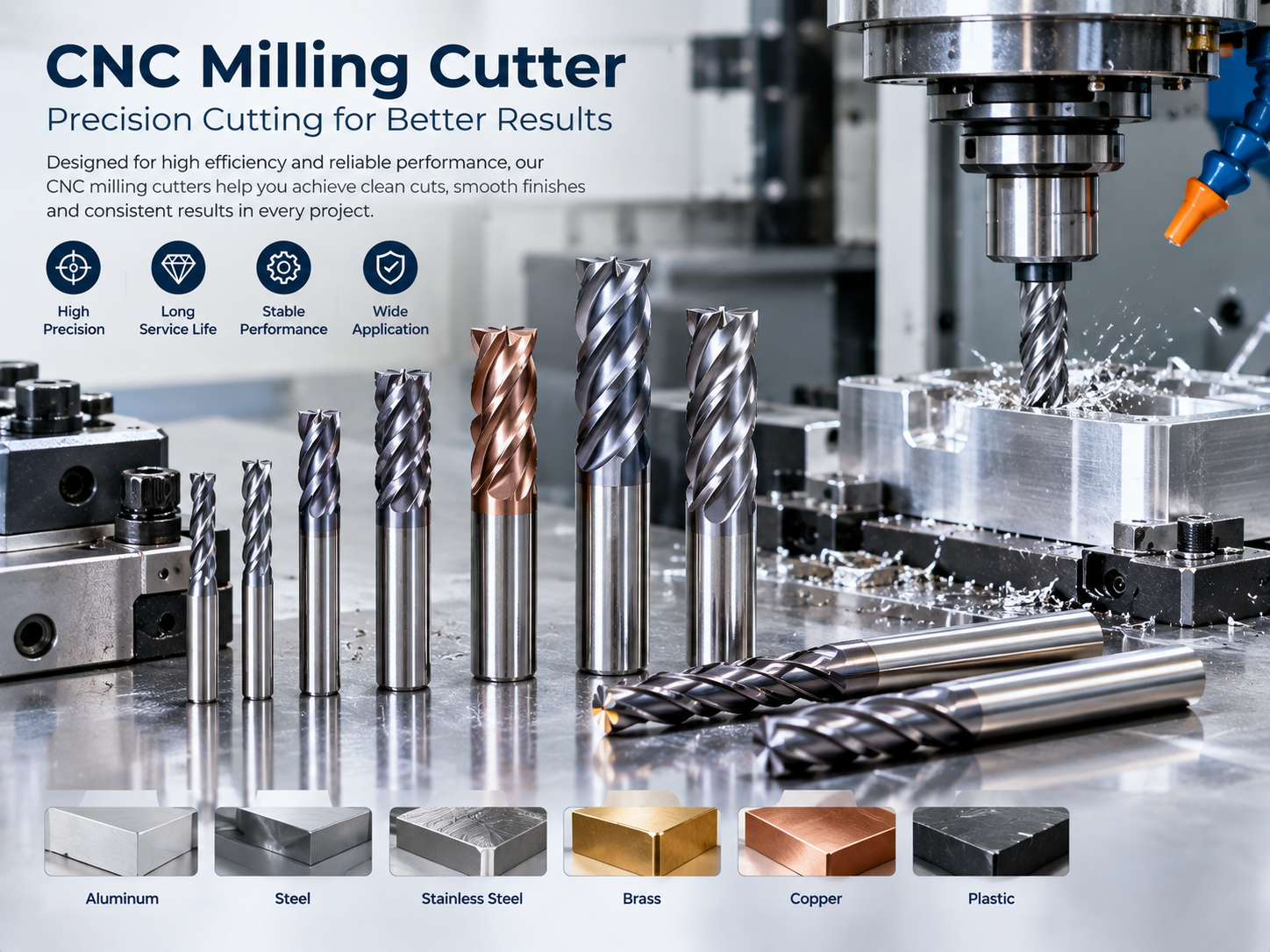
A milling cutter removes material as its cutting edges repeatedly contact the workpiece. The way the metal reacts to that contact has a direct effect on the tool.
Aluminum is relatively soft and transfers heat well, but it can produce sticky chips that build up around the cutting edge. Carbon steel covers a fairly wide range of grades and hardness levels. Stainless steel can be tougher to machine, generate considerable heat, and in some cases work-harden when the tool rubs instead of cutting properly.
That is why cutter selection changes from one material to another.
| Material | Main machining concern | General cutter direction |
|---|---|---|
| Aluminum | Chip evacuation and built-up edge | Sharp, polished cutting edges |
| Carbon steel | Tool wear and cutting load | Durable carbide geometry |
| Stainless steel | Heat, work hardening, edge wear | Tough geometry and suitable coating |
These are starting points, not fixed rules. The actual alloy, hardness, machine, and machining operation still need to be considered.
Aluminum alloys are often machined at relatively high cutting speeds. Since aluminum is softer than most steels, a sharp cutting edge is usually useful.
Aluminum cutters may use polished flutes, larger chip spaces, and higher helix angles to help move chips away from the cutting area.
Two- and three-flute designs are commonly used when high feed rates and good chip evacuation are needed.
A cutter intended for aluminum often focuses on:
The idea is pretty straightforward: get the chips out before they have a chance to stick to the tool or get cut again.
More flutes mean more cutting edges, but they also mean less space for chips.
That trade-off matters with aluminum because a large amount of material can be removed quickly, producing plenty of chips.
| Flute count | General consideration for aluminum |
|---|---|
| 2 flutes | Large chip space and good evacuation |
| 3 flutes | Balance between chip space and feed capability |
| 4+ flutes | More cutting edges, but less flute space |
For roughing and high-speed aluminum work, two- or three-flute cutters are often considered. A finishing operation may call for something different depending on the required surface and feed rate.
Steel is a much broader category, so there is no single cutter specification that covers every steel grade.
For common carbon and low-alloy steels, carbide end mills with relatively strong cutting edges are widely used. Compared with aluminum machining, the tool has to deal with higher cutting forces.
Steel cutters may use:
The geometry can change again depending on whether the operation involves roughing, slotting, profiling, or finishing.
Coatings in the TiAlN family are often considered for steel machining because they can provide useful heat and wear resistance under suitable conditions. Still, coating selection should be based on the actual steel grade and machining setup.
Stainless steel can be more demanding than ordinary carbon steel.
Many stainless grades are tough and can generate a lot of heat during machining. Austenitic stainless steels are also known for work hardening when the cutting edge rubs against the surface or when cutting conditions are not suitable.
That makes cutter sharpness, machine rigidity, feed rate, and heat control especially important.
For stainless steel, buyers may look for:
There is also a practical point here: don't keep running a worn cutter just because it still technically cuts. As the edge gets dull, cutting forces and heat can rise, making the machining problem harder to control.
A quick comparison gives buyers a useful starting point.
| Feature | Aluminum | Carbon Steel | Stainless Steel |
|---|---|---|---|
| Typical edge preference | Very sharp | Strong and durable | Sharp but supported |
| Flute space | Large | Medium | Medium to large depending on operation |
| Common flute range | 2–3 | 3–5+ | 3–5+ |
| Coating priority | Often lower | High for many applications | Often important |
| Main challenge | Chip adhesion | Wear and cutting load | Heat and work hardening |
| Typical cutting speed | Higher | Moderate | Moderate to lower |
The table is only a general reference. Different alloys within the same material group can behave quite differently.
Industrial CNC milling cutters are often made from cemented carbide because carbide provides the hardness and wear resistance needed for demanding machining.
But “carbide” doesn't tell the whole story. Carbide grades vary.
Tool selection often involves a balance between hardness and toughness. A harder grade may offer better wear resistance, while a tougher grade can handle interrupted cuts and mechanical shock more effectively.
For aluminum, cutting-edge sharpness and surface finish can be particularly important. Harder steels put more emphasis on wear resistance. Stainless steel often requires a reasonable balance between toughness and heat resistance.
For B2B buyers, asking for the actual carbide grade or manufacturer's specification is much more useful than simply asking whether a cutter is carbide.
Tool coatings can reduce friction and improve wear resistance and heat handling when they are properly matched to the application.
The material still matters.
With aluminum, sticky chips and material adhesion can be a concern. Highly polished uncoated cutters or coatings intended for non-ferrous materials may be considered.
Steel and stainless steel often place more emphasis on heat and wear resistance.
| Material | Coating consideration |
|---|---|
| Aluminum | Polished or low-friction surface; suitable non-ferrous coating |
| Carbon steel | Wear- and heat-resistant coating |
| Stainless steel | Heat resistance and edge stability |
There isn't a coating that automatically solves every machining problem. Cutting speed, coolant, machine rigidity, and production volume all influence the choice.
Even a suitable cutter can perform badly if the spindle speed or feed rate is off.
Cutting speed can be estimated using:
where:
V_c = cutting speed in m/minD = cutter diameter in mmn = spindle speed in RPMFeed per tooth can be estimated as:
where:
f_z = feed per toothV_f = feed raten = spindle speedz = number of teethTool manufacturers normally provide recommended starting ranges for particular materials and cutter specifications. Those figures are useful, but the actual machine and workholding can still change what works in practice.
Cooling and lubrication requirements can vary considerably between materials.
Aluminum often benefits from good chip evacuation and lubrication that limits material sticking to the cutter. Steel and stainless steel may put more emphasis on controlling cutting heat.
Dry machining, flood coolant, minimum quantity lubrication, and other methods can all be suitable in different situations. The decision depends on the machine, alloy, cutter, and production process.
Poor coolant delivery can leave chips sitting in the cutting zone. That can increase heat and may shorten tool life.
So when buyers evaluate a cutter, it helps to consider the complete machining setup instead of looking at the tool alone.
There is no real need for one cutter to handle every stage of machining.
Roughing is mainly about removing material efficiently. Finishing is more concerned with surface quality, dimensional accuracy, and controlled edge behavior.
A shop machining stainless steel, for example, might use a stronger cutter for roughing and another cutter with different geometry for finishing.
| Machining stage | Main cutter priority |
|---|---|
| Roughing | Strength, chip evacuation, material removal |
| Semi-finishing | Balance of speed and surface quality |
| Finishing | Edge quality, dimensional control, surface finish |
For production work, using separate cutters for different stages can make sense when the extra tooling cost is justified by the process requirements.
The machine can put a practical limit on what a cutter can do.
A rigid CNC machine with accurate spindle alignment can generally handle more demanding cutting conditions. A less rigid setup may need lighter cuts to keep vibration under control.
Some important machine factors include:
Vibration is a particular concern. It can damage cutting edges, affect surface finish, and make tool life much less predictable.
For B2B buyers, the machine specifications should therefore be part of the cutter discussion.
A larger cutter can provide useful rigidity, but the diameter still needs to match the feature being machined.
Tool overhang is another common issue. The farther the cutter extends from the holder, the more likely deflection and vibration become, especially in harder materials such as stainless steel.
When possible, use enough working length to reach the feature without adding unnecessary extension.
Buyers should provide details such as:
With this information, a tooling supplier has a much clearer idea of what the cutter needs to handle.
A practical selection approach can be broken down by material.
Look for sharp cutting edges, polished flutes, enough chip space, and efficient chip evacuation. Two- or three-flute cutters are commonly considered when high chip loads and feed rates are involved.
Pay more attention to carbide strength, wear resistance, coating, and flute geometry. The actual steel grade and hardness should be provided to the tooling supplier.
Heat control becomes more important. Buyers should consider edge toughness, suitable coatings, chip evacuation, and cutting conditions that keep the tool cutting instead of rubbing against the material.
These are useful starting points, but actual trials are still valuable when machining an unfamiliar alloy or moving into high-volume production.
Before ordering a CNC Milling Cutter, buyers should give the supplier enough information to understand the application.
| Information | Why it matters |
|---|---|
| Workpiece material | Determines cutter geometry |
| Material hardness | Influences edge strength and coating |
| Cutter diameter | Affects rigidity and RPM |
| Flute count | Influences chip evacuation and feed |
| Cutting depth | Helps determine tool length |
| Spindle speed | Supports parameter selection |
| Coolant method | Affects heat and chip control |
| Roughing or finishing | Determines geometry priorities |
| Machine type | Establishes practical limits |
| Required surface finish | Helps select finishing geometry |
The more specific the application information, the less likely the recommendation will be based on a generic “one tool fits all” approach.
Before making a cutter part of a standard production process, practical testing is useful.
Operators can compare:
For larger production programs, tool-life testing can also help calculate the actual cost per part.
A cheaper cutter may not save money if it needs frequent replacement or causes more rejected parts. Looking at tool cost together with production performance gives buyers a more realistic comparison.
| Workpiece | Cutter characteristics to consider |
|---|---|
| Aluminum | Sharp, polished, large flute space |
| Low-carbon steel | Durable carbide and suitable coating |
| Alloy steel | Wear resistance and stronger edge geometry |
| Stainless steel | Tough edge, heat-resistant coating, good chip evacuation |
| Hardened steel | Specialized carbide and geometry |
| Mixed production | Application-specific tooling for each material |
A general-purpose cutter can be convenient for a mixed shop, but when production volume or surface requirements increase, material-specific tooling may be worth considering.
There isn't one CNC Milling Cutter that behaves the same way on aluminum, carbon steel, and stainless steel.
Aluminum usually benefits from sharp edges, polished flutes, and plenty of chip space. Carbon steel calls for a balance of edge strength, wear resistance, and suitable coating. Stainless steel needs closer attention to heat, work hardening, cutter toughness, and cutting conditions.
For B2B buyers, the selection process should start with the actual material grade and hardness, then move on to the machining operation, machine capability, and production target. From there, flute count, cutter geometry, carbide grade, coating, and dimensions can be narrowed down.
Cutter selection gets much easier when the tool and machining process are considered together. Material, geometry, spindle speed, feed rate, coolant, tool holder, and machine rigidity all affect what happens at the cutting edge.
For manufacturers, distributors, and machining companies, working with a tooling supplier that can provide application guidance and sample testing can also reduce guesswork. A cutter that looks suitable on paper still needs to prove that it can handle the actual material and machining conditions.
KEEP IN ToUCH

Rongcheng specializes in manufacturing and exporting wood planer bits, auger bits, shovel bits, spade bits, chisels, hammer bits and carbide, etc.
contact us
Address: Shangbutou, Qingjiang, Yueqing, Zhejiang, China
Tel: +86-577-62271200
FAX: +86-577-62276882
E-mail: [email protected]
Follow us

Carbide Hammer Drill Tools Manufacturer

 English
 русский
 Español
 中文简体
中文简体