2026-11-27
A Forstner bit may look like a simple woodworking accessory, but its cutting edges have a demanding job. They need to score a clean circle, remove material from the bottom of the hole, and keep cutting accurately as friction builds up. In furniture production, where dozens or hundreds of hinge recesses may be drilled in a shift, edge wear quickly becomes noticeable.
The material used to make the bit affects how well it handles that workload. Carbon steel, HSS, and carbide-based designs serve different purposes, and their cost differences are not just a matter of raw materials. OEM buyers need to consider how each option performs in the wood products their customers actually use.
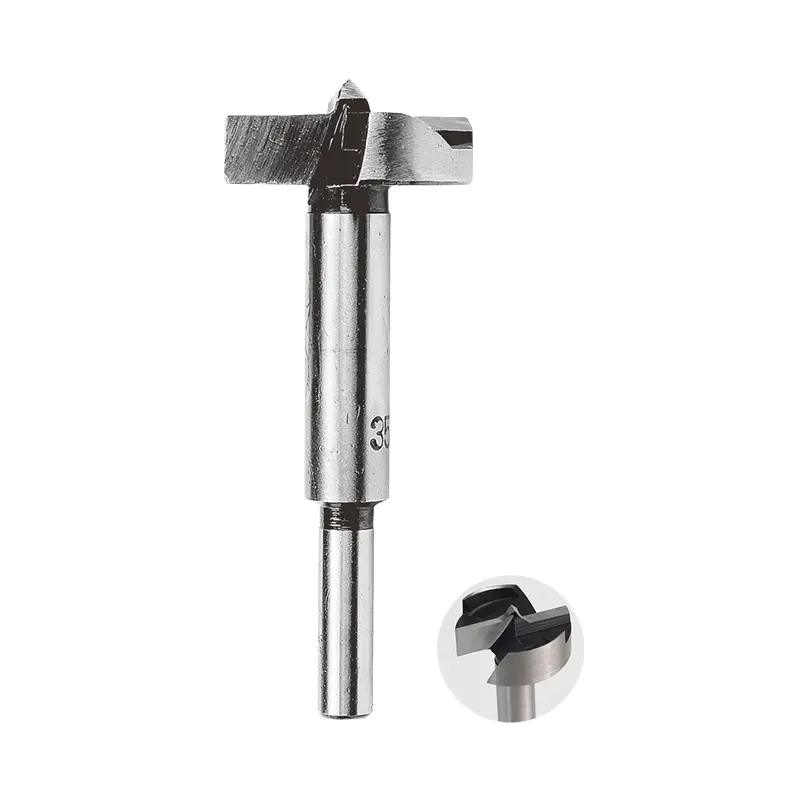
What Are Forstner Bits and How Does Their Cutting Structure Work?
Forstner bits are designed to bore flat-bottomed holes with clean edges. A typical bit has a center point for positioning, a circular rim that cuts around the hole, and internal cutting edges that clear material from the bottom.
Unlike a standard twist drill, a Forstner bit can also make overlapping holes or cut close to the edge of a workpiece. These operations put considerable demands on the rim and internal cutters. If either loses its edge, the hole may become rough, drilling may require more pressure, and heat can build up.
That is where material selection starts to matter. A bit used occasionally in solid wood has different requirements from one running continuously through MDF or laminated panels.
Common Material Options for Forstner Bit Manufacturing
1. Carbon Steel
Carbon steel is often used in economical Forstner bit ranges. It is relatively easy to machine and heat-treat, making it suitable for products where keeping the selling price low is a priority.
For occasional woodworking, its cutting performance may be perfectly adequate. The limitation becomes more apparent during long production runs. The edges generally wear sooner than those on higher-performance tool materials, particularly when drilling abrasive boards or working at high speeds.
OEM buyers should not assume that all carbon steel bits are equivalent. Finished hardness and heat treatment can vary, so sample testing is useful even for an entry-level product.
2. High-Speed Steel (HSS)
HSS is commonly chosen for tools expected to withstand repeated cutting and higher operating temperatures. It holds its hardness better under heat than many standard carbon steel grades, which helps the cutting edges retain their shape during sustained use.
Forstner bits made from HSS are a natural fit for professional woodworking ranges. However, the letters HSS on a product specification do not tell buyers everything they need to know. Steel grade, heat treatment, and grinding quality all affect the finished tool. A poorly ground HSS bit can disappoint despite its higher material cost.
3. Carbide-Tipped Steel
Carbide-tipped bits use a steel body with cemented carbide cutting elements. This combination gives the tool a supporting structure while providing harder, more wear-resistant edges.
The design is particularly relevant to furniture factories processing MDF, particleboard, and laminated panels. Abrasive wood-based materials can dull steel cutters relatively quickly, so carbide tips may reduce how often tools need replacing or resharpening.
There is a manufacturing trade-off. Carbide is hard but brittle, and the tips must be brazed and ground accurately. Weak joints, poor positioning, or careless handling can cause chipping or tip separation.
4. Solid Carbide
Solid carbide Forstner-style tools serve more specialized applications. They offer high wear resistance, but their purchase price is considerably higher than that of conventional steel designs.
They are not automatically the best option for every industrial buyer. Carbide is less tolerant of impact and misalignment, so the machine setup and operating conditions need to suit the tool. For many OEM ranges, carbide-tipped construction may provide a more economical balance.
Comparing Forstner Bit Materials for OEM Purchasing
| Material | Main Advantage | Main Limitation | Typical Product Range |
|---|---|---|---|
| Carbon Steel | Low production cost | Faster edge wear under demanding use | Entry-level woodworking tools |
| HSS | Better heat resistance and edge retention | Higher material and processing costs | Professional woodworking tools |
| Carbide-Tipped Steel | Hard, wear-resistant cutting edges | Brittle tips and more complex assembly | Heavy-use and engineered wood applications |
| Solid Carbide | High wear resistance and dimensional stability | High cost and sensitivity to impact | Specialized industrial tooling |
These are broad comparisons. Actual results depend on the material grade, heat treatment, cutting geometry, and manufacturing accuracy.
How Material Selection Affects OEM Manufacturing Costs
A carbon steel bit is generally less complicated to produce. HSS needs controlled heat treatment and precision grinding, while carbide-tipped models require additional work to prepare, braze, and inspect the cutting elements. Solid carbide brings its own machining and grinding costs.
The difference also shows up in production yield. Inconsistent heat treatment can cause rejected steel tools; poor brazing can make carbide-tipped products unreliable. A low quotation does not necessarily mean a low final cost if a large percentage of the batch fails inspection.
When comparing suppliers, look beyond the unit price. Ask how they control hardness, inspect cutting edges, check dimensions, and handle defective products. Expected tool life matters too. A more expensive bit may cost less per hole if it lasts significantly longer in production.
Important Quality Checks When Sourcing Forstner Bits
Several checks are worth including in an OEM inspection plan:
During drilling tests, record more than whether the bit can make a hole. Hole diameter, bottom flatness, edge quality, vibration, and wear after repeated use all provide useful information.
How OEM Buyers Can Build a More Reliable Tool Sourcing Strategy
The intended application should guide the specification. A low-cost bit for occasional DIY use does not need the same material requirements as a tool used throughout a furniture production shift.
Tell the manufacturer which workpieces the bits will encounter and how frequently they will be used. Specify the required material, hardness, dimensions, and cutting geometry. Then test samples under realistic conditions before approving the production order.
This is especially important for carbide-tipped products, where tip attachment and grinding quality can vary between suppliers. A sample that performs well is a useful starting point, but production batches still need inspection.
Developing Competitive Forstner Bit Products Through Material Engineering
There is little value in paying for solid carbide when the target customer only drills softwood occasionally. Equally, putting low-cost carbon steel into a tool intended for continuous MDF production can lead to early wear and customer complaints.
For OEM buyers, the material specification should reflect the actual workload, not simply the highest available grade. Compare samples on the intended workpieces, check manufacturing consistency, and calculate cost against expected tool life. Those results provide a much firmer basis for choosing a supplier than a material label or unit price alone.
KEEP IN ToUCH

Rongcheng specializes in manufacturing and exporting wood planer bits, auger bits, shovel bits, spade bits, chisels, hammer bits and carbide, etc.
contact us
Address: Shangbutou, Qingjiang, Yueqing, Zhejiang, China
Tel: +86-577-62271200
FAX: +86-577-62276882
E-mail: [email protected]
Follow us

Carbide Hammer Drill Tools Manufacturer

 English
 русский
 Español
 中文简体