2026-11-20
Drilling a deep hole through a thick timber beam is a different job from making a quick opening for electrical cable in a wall stud. Both tasks involve removing wood, but the cutting tool has a considerable effect on how quickly the work gets done, how much force the drill needs and what the finished hole looks like.
Auger bits and spade bits are designed around two different cutting approaches. One uses a spiral body to carry chips away from the cutting area, while the other relies on a flat paddle with two cutting edges. Understanding the differences between Auger Bits Vs Spade Bits helps contractors and woodworking professionals avoid using a tool that makes an otherwise straightforward drilling job unnecessarily difficult.
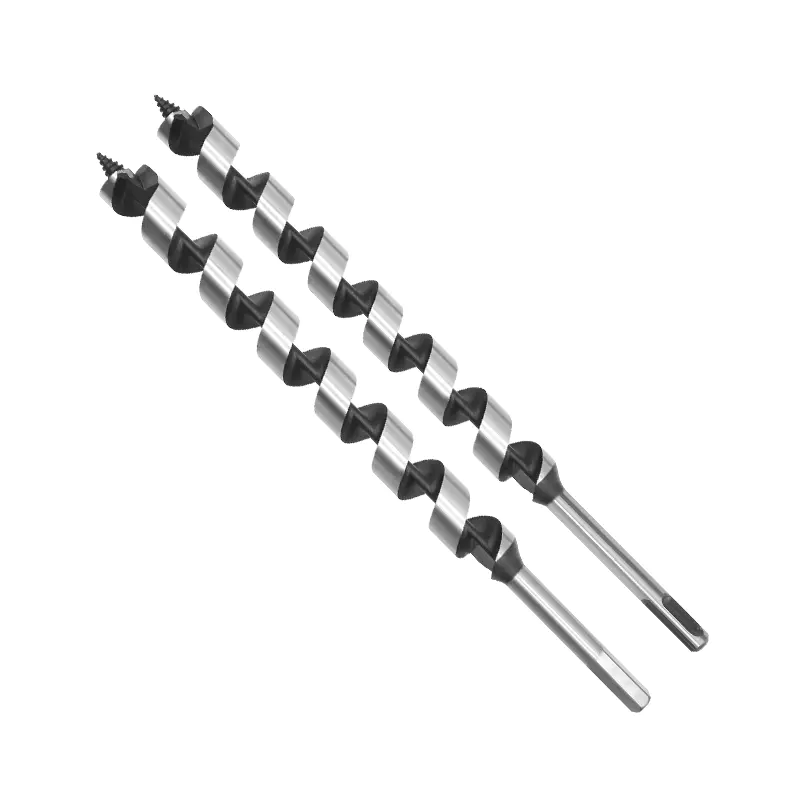 Why Auger Bits Work Well for Deep Holes
An auger bit has a distinctive spiral body, a pointed lead screw and cutting edges near its tip. Each part contributes to the drilling process.
The lead screw engages the wood first and pulls the bit forward as it rotates. This reduces the amount of pushing force required from the operator, although the drill still needs enough torque to handle the cutting load.
The cutting lips remove material around the center point, while the spiral flute carries wood chips toward the opening. This is particularly useful when drilling deep into solid timber, where accumulated chips can otherwise interfere with cutting.
Auger bits are commonly used for:
Their spiral construction is a major advantage when the hole depth makes chip removal difficult. However, larger auger bits can demand considerable torque, so drill compatibility should be checked before use.
How the Flat Cutting Edges of a Spade Bit Work
A spade bit has a much simpler structure. Its flat paddle-shaped body carries a pointed center tip and two main cutting edges. Some versions also have small outer spurs that help define the hole perimeter.
When the drill rotates, the center point keeps the bit aligned while the cutting edges remove wood from the surrounding area. This straightforward geometry allows material to be removed quickly, making spade bits useful for routine construction drilling.
There is a limitation, particularly with deeper holes. Unlike an auger bit, a standard spade bit does not have a long helical flute to transport chips continuously out of the hole. Wood debris can accumulate around the cutting edges, so the operator may need to withdraw the bit several times.
Typical applications include:
Spade bits are also relatively economical and easy to store, which makes them popular among contractors who need several diameters on site.
Auger Bits Vs Spade Bits: Performance Differences
The cutting geometry affects more than appearance. It influences chip removal, drilling depth, required torque and the amount of cleanup after drilling.
| Performance Factor | Auger Bit | Spade Bit |
|---|---|---|
| Cutting Geometry | Spiral body, lead screw and cutting lips | Flat paddle with center point and cutting edges |
| Chip Removal | Helical flute carries chips out of the hole | Less efficient, particularly in deep holes |
| Drilling Depth | Well suited to deeper boring | More suitable for shallow and moderate depths |
| Hole Finish | Generally offers more controlled cutting | Can produce rougher edges and breakout |
| Drilling Speed | Effective for controlled deep boring | Often fast in suitable timber |
| Typical Application | Deep holes and structural timber | Framing and quick service openings |
Neither design is automatically faster in every situation. Wood density, bit diameter, cutting-edge condition and drill power all affect the result.
Which Bit Produces a Cleaner Hole?
Hole quality depends heavily on how the cutting edges interact with the wood fibers.
An auger bit uses its cutting lips and outer cutting features to remove material progressively. Its spiral flute also helps prevent chips from accumulating around the cutting area. This can produce a more controlled hole, particularly when drilling through thicker timber.
Spade bits are often used where the hole will be hidden behind a fixture, inside a wall or beneath another component. They can produce usable openings quickly, but tearing around the exit surface is more likely if the bit breaks through without support.
A few practical steps help with either tool:
For visible furniture components or fine woodworking, a different drilling method or additional finishing may be preferable.
Wood Type and Drill Compatibility Matter Too
The same bit can behave differently in softwood and hardwood. Dense hardwood generally creates greater cutting resistance, while grain direction and moisture content can also affect chip formation.
Bit diameter is another important consideration. A large auger bit can place substantial torque demands on the drill, particularly when boring deeply. A spade bit may also bind if it is forced through dense timber or if accumulated chips restrict its movement.
Before starting work, check the following:
Avoid forcing a bit through resistant material. Sudden binding can twist the drill, damage the workpiece or cause loss of control.
What Professional Buyers Should Consider
For construction contractors, furniture manufacturers and tool distributors, purchasing decisions should account for more than the initial unit price.
Auger bits need consistent spiral geometry, accurately formed cutting lips and a properly aligned lead screw. Spade bits require attention to paddle thickness, cutting-edge symmetry and center-point geometry.
Heat treatment, material hardness, dimensional accuracy and surface finish also influence service life. Buyers placing bulk orders should inspect samples from actual production batches rather than relying entirely on catalogue specifications.
Choose the Cutting Geometry for the Job
The difference between Auger Bits Vs Spade Bits becomes clear when drilling conditions are considered. Auger bits are particularly useful for deep holes where chip removal and controlled boring matter. Spade bits are a practical choice for quick openings in framing timber and other routine construction work.
For professional users, the decision usually comes down to hole depth, wood density, required finish and available drill torque. Matching these conditions to the bit's cutting geometry helps avoid unnecessary drilling effort, premature tool wear and poor-quality holes.
KEEP IN ToUCH

Rongcheng specializes in manufacturing and exporting wood planer bits, auger bits, shovel bits, spade bits, chisels, hammer bits and carbide, etc.
contact us
Address: Shangbutou, Qingjiang, Yueqing, Zhejiang, China
Tel: +86-577-62271200
FAX: +86-577-62276882
E-mail: [email protected]
Follow us

Carbide Hammer Drill Tools Manufacturer

 English
 русский
 Español
 中文简体